
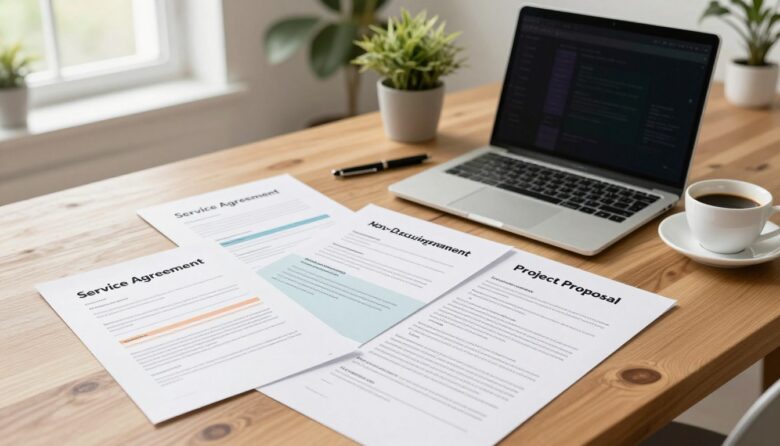
Before adapting a freelance contract template, collect the facts that make the agreement fit the engagement: the parties’ legal names, services, deliverables, deadlines, payment process, ownership expectations, confidentiality needs, and exit terms. Then check whether the template matches your state, industry, client relationship, and level of risk. A template can organize information, but it is not legal advice and does not automatically make an agreement enforceable or suitable for your situation. For unusual, high-value, regulated, or disputed work, qualified legal review may be appropriate.
What should a freelancer collect before opening a template?
A contract is easier to evaluate when you know the actual deal you are trying to document. Gather these details first rather than filling blanks as you go.
- Each party’s identity: Record the freelancer’s legal name or business entity, the client’s legal name, business address, primary contact, and the person authorized to sign.
- Business relationship: Confirm that the engagement is intended to be an independent-contractor relationship and identify any practical expectations about scheduling, supervision, equipment, and work location.
- Business purpose: Write a short description of the project and the result the client is seeking.
- Scope information: List services, deliverables, formats, quantities, milestones, deadlines, dependencies, and the client’s review responsibilities.
- Commercial terms: Gather the fee, currency, deposit or milestone schedule, invoice method, payment deadline, taxes, and approved expenses.
- Change decisions: Decide how additional work, new deadlines, extra revisions, and out-of-scope requests will be approved and priced.
- Rights and restrictions: Identify pre-existing materials, third-party assets, new work, licenses, ownership transfers, portfolio use, and any credit requirements.
- Information handling: Determine what information is confidential, who may access it, how it must be stored or returned, and how long obligations should last.
- Ending the engagement: Decide whether either party can terminate for convenience, what notice is required, what happens after a breach, and how completed work will be paid for.
Keep supporting information with the draft: the proposal, statement of work, creative brief, specifications, approved estimate, and any email that changes the deal. The contract should identify which document controls if those materials conflict.
Which contract documents might a freelancer need?
There is no universal set of templates. The right document depends on whether you are documenting one project, an ongoing relationship, or a special risk.
Independent contractor agreement
This is the main framework for the relationship. It may cover services, payment, confidentiality, intellectual property, independent status, warranties, termination, dispute procedures, and general administrative terms. For a short, simple assignment, one agreement may be enough. For recurring work, a master services agreement can establish general terms while separate statements of work describe each project.
Statement of work or project addendum
A statement of work makes the assignment concrete. It should connect the project to the broader agreement and describe the specific deliverables, schedule, assumptions, acceptance process, and fee. This structure can be easier to update than rewriting every general term for each client.
Proposal with contractual terms
Some freelancers use a proposal that becomes binding when accepted. Before relying on that format, confirm that it clearly identifies the parties, acceptance method, scope, payment terms, and other provisions that matter. A visually polished proposal can still leave important legal and operational questions unanswered.
Confidentiality agreement
A separate nondisclosure agreement may be useful when sensitive information will be shared before the main contract is signed or when the client has detailed confidentiality requirements. Check for definitions, permitted use, exceptions, security expectations, compelled disclosure, return or deletion, and the duration of the obligation.
Intellectual property assignment or license
Some projects need more detail than a standard ownership paragraph. A separate assignment or license can distinguish the freelancer’s background materials, licensed assets, tools, drafts, and final deliverables. The document should also address payment conditions for any transfer, if applicable.
How do you check the scope and deliverables?
Scope problems often begin with broad phrases such as complete the project, provide design support, or make revisions as needed. Replace general language with information someone outside the project could use to identify what is included.
Describe the work
Name the services, subject matter, channels, file types, quantities, and technical or editorial requirements. State what is not included when exclusions are important.
Define completion
Explain what counts as delivery, who reviews the work, how feedback is provided, and whether acceptance is based on objective specifications or client approval.
Limit revisions
State how many review rounds are included, what a revision means, and how changes to an approved direction affect the fee or schedule.
Record dependencies
Identify client-supplied content, access, approvals, decisions, and third-party materials. Explain what happens when those inputs arrive late.
Use a schedule that is specific enough to manage the work but flexible enough to handle genuine dependencies. If a deadline is important, identify the event that starts the clock and whether the date changes when the client delays feedback or materials.
What payment information belongs in the checklist?
Do not stop at the total fee. A useful payment section answers how the amount is earned, when invoices are sent, and what happens when the project changes.
- Is the fee hourly, fixed, milestone-based, retainer-based, or a combination?
- What work, time, or deliverable triggers each invoice?
- When is payment due, and how must the client pay?
- Are deposits refundable, applied to the final amount, or treated differently if the project ends early?
- Who pays transaction fees, taxes, travel, software, stock assets, subcontractors, or other approved expenses?
- Can the freelancer pause work for overdue invoices, and what notice is required?
- How are disputed invoice items raised and resolved without withholding unrelated amounts?
- Are late charges allowed, and do they comply with applicable law and the agreement?
Make sure the contract, invoice instructions, and proposal use the same fee and payment language. A template may include a late-fee clause or collection remedy that is unsuitable for your jurisdiction or client type. That is a point to verify, not a term to assume is valid.
How should you review intellectual property terms?
Ownership language can change the value and future usability of creative, technical, written, or strategic work. First separate what you already owned from what you will create for the client. Background materials may include methods, templates, code libraries, processes, fonts, stock assets, or reusable components. The contract should not accidentally transfer rights you need for other work unless that is intended and properly addressed.
Then identify the intended arrangement:
- Assignment: The freelancer transfers specified rights, usually subject to stated conditions and exclusions.
- License: The freelancer retains ownership while granting the client defined rights, such as particular media, territories, users, duration, or purposes.
- Third-party materials: The client receives only the rights available under the applicable vendor or creator license.
- Portfolio use: The contract states whether and when the freelancer may display the work, name the client, or use excerpts after public release.
Do not assume that calling work work made for hire settles every ownership question. The statutory rules are specific, and treatment can depend on the type of work and the parties’ relationship. Assignment language, licenses, moral-rights issues, registration matters, and rights in underlying materials may require qualified legal review.
What confidentiality and data questions should you ask?
A confidentiality clause should describe the information and permitted handling, not simply label everything confidential. Check whether it covers client lists, pricing, product plans, credentials, personal information, source code, unpublished content, and information received from other parties.
Look for ordinary exceptions, such as information that is public without a breach, already known, independently developed, or lawfully received from another source. Confirm whether the freelancer may use subcontractors or service providers and what safeguards apply. If personal information, health information, payment data, children’s information, or regulated records are involved, a general template may be inadequate. The client may need specific security, breach-notification, retention, or data-processing terms.
Which termination, liability, and dispute terms deserve attention?
These clauses can matter most when the relationship is no longer going smoothly. Read them together instead of approving each provision in isolation.
- Termination: Check termination for convenience, termination for breach, notice method, any cure period, payment for work completed, treatment of deposits, and delivery of partially completed materials.
- Suspension: Determine whether work may stop when invoices are overdue, required inputs are missing, or the client requests a material change.
- Warranties: Identify promises about originality, performance, deadlines, legal rights, accessibility, security, or results. Avoid accepting promises you cannot verify or control.
- Indemnity: Understand which claims are covered, who controls the defense, whether notice is required, and whether the obligation is mutual or one-sided.
- Liability limits: Check any cap, exclusions, carve-outs, and relationship to insurance. A limitation may not apply in every circumstance.
- Disputes: Review governing law, venue, mediation, arbitration, court access, attorneys’ fees, and the process for formal notices.
Broad indemnity, uncapped liability, personal guarantees, mandatory arbitration, noncompete restrictions, exclusivity, and continuing obligations deserve careful consideration. A freelancer should understand the practical exposure before agreeing, and may want a qualified attorney to review the language.
What to verify before using a template
- Source and date: Identify who published the template, when it was updated, and whether it is written for the United States or a particular state.
- Definitions: Confirm that terms such as services, deliverables, confidential information, work product, business day, and approval mean what you intend.
- Internal consistency: Compare every section, exhibit, proposal, and statement of work for conflicting dates, fees, ownership terms, or notice requirements.
- Missing facts: Replace every bracket, placeholder, optional clause, generic reference, and blank schedule. Do not leave uncertainty disguised as boilerplate.
- Authority to sign: Verify the client’s legal entity and whether the signer is authorized to bind it.
- Practical operation: Ask whether both parties can actually follow the invoicing, approval, security, notice, and recordkeeping procedures.
- Local and industry fit: Check state law, licensing rules, tax treatment, worker-classification concerns, privacy duties, and client procurement requirements.
- Professional review: Get qualified legal advice when the financial or legal consequences are significant, the terms are heavily one-sided, or the work involves unusual risk.
Templates are general information and are not legal advice. AIM Solutions does not determine whether a contract is enforceable, whether a worker is properly classified, or which laws apply. Consider advice from a qualified professional who can review the actual parties, facts, and jurisdiction. You can also review our disclaimer and editorial policy.
A practical way to decide
- Rate the engagement. Note the contract value, duration, access to systems or data, number of deliverables, public visibility, and consequences of delay or error.
- Choose the simplest suitable structure. A basic agreement and scope may suit a small, clearly defined assignment. Ongoing or complex work may call for a master agreement plus statements of work.
- Mark the pressure points. Highlight ownership, confidentiality, payment, revisions, liability, indemnity, termination, exclusivity, and dispute provisions.
- Compare the draft with the actual conversation. Resolve differences before signing. An email promise that is missing from the contract may be difficult to rely on later.
- Escalate when the risk is material. Ask for professional review rather than guessing about unfamiliar legal language or accepting a term you cannot evaluate.
- Finalize the record. Make sure the correct entities sign and date the same version. Store the executed agreement with the scope, invoices, approvals, and amendments.
Hypothetical example
Hypothetical example: A freelance designer is asked to create a brand package for a new company. The proposal lists a logo, color palette, and two revision rounds, but the client also expects social-media templates and editable source files. Before adapting a template, the designer would list those additional deliverables, identify the source-file format, set approval dates, clarify whether third-party fonts are included, and decide whether the client receives an assignment or a license. If the client requests unlimited revisions and broad indemnity, those terms would be flagged for negotiation and possible legal review rather than silently accepted.
How should you sign and store the final agreement?
Use a signing process that shows which version each party accepted. Save the signed agreement as a PDF, retain the editable working file separately, and label the record with the client, project, and effective date. Store the scope, amendments, approvals, invoices, and payment records where you can retrieve them together. Limit access to sensitive files and follow any applicable retention or deletion commitments.
For a later change, use a written amendment, updated statement of work, or other method allowed by the agreement. Record the change before performing the additional work when possible. If a dispute is already developing, preserve relevant communications and seek appropriate professional advice instead of relying on a template alone.
Frequently asked questions
Can I use one freelance contract for every client?
You can keep a standard starting form, but each engagement should be checked for its parties, scope, payment, rights, confidentiality, risk, and jurisdiction. Reusing a template without reviewing those facts can leave important terms inaccurate or missing.
Do I need a separate statement of work?
Not always. A single agreement may work for a short, well-defined assignment. A separate statement of work can be useful when general terms will stay the same while project details change from one engagement to another.
Does signing a template make me an independent contractor?
No. Classification can depend on the actual working relationship and applicable law, not only the label in a contract. Consider professional advice if the client controls your work in ways that may raise classification questions.
When should a freelancer ask a lawyer to review a contract?
Consider review for high-value or long-term engagements, unfamiliar jurisdictions, complex intellectual property, regulated or personal data, exclusivity, noncompete restrictions, personal guarantees, broad indemnity, uncapped liability, or any term you do not understand.
What if the client will not sign?
Ask whether the client has a standard agreement and compare it with your needs. At minimum, document the parties, services, deliverables, payment, timing, ownership, and approval process in writing. If the client wants work to begin while terms remain unresolved, assess the risk carefully and consider qualified legal advice.
Keep the checklist current. Update your starting template when your services, business structure, tools, rights model, or risk profile changes. For questions about your specific agreement, contact a qualified professional. For questions about this resource, visit AIM Solutions contact.
How this guide was prepared
This article was prepared by the AIM Solutions Editorial Team to help readers evaluate templates and workflows without replacing legal, financial, HR, compliance or other professional advice.