
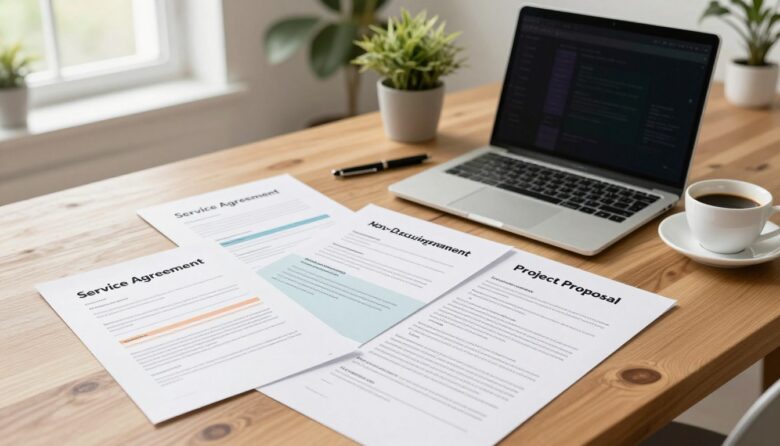
I believe a clear contract is the fastest way to protect your time and income. I always send a simple freelance agreement before I start any work. This lets both sides agree on scope, pay, and deadlines.
A well-structured document reduces confusion and keeps payments on track. When I use professional contracts, I cut the risk of unpaid work and disputes.
You can find free online templates that help you run your business and secure income. I recommend customizing each template to match the job and adding clear payment terms to every contract.
Key Takeaways
- Send an agreement before starting any work to set expectations.
- Use a clear document to define scope, payment, and timelines.
- Professional contracts protect your business from disputes.
- Free templates can save time, but customize them for each job.
- Include precise payment terms to avoid lost income.
Understanding the Role of a Freelance Contract
Starting a new engagement means clarifying who will do what, when, and for how much. I find a short written agreement removes uncertainty fast. It sets expectations for both sides before any work begins.
Defining the independent relationship
Defining the Freelancer Relationship
A freelancer is a self-employed worker hired to deliver services or complete a project. They are not an employee and can work with multiple businesses at once. That independent status shapes tax, liability, and scheduling decisions.
The Purpose of a Contract
The purpose of a contract is to record key terms so the client and I share the same information. A clear document explains deliverables, payment, and deadlines. This helps both parties avoid disputes and resolve issues quickly.
- Confirms scope and services
- Sets payment and timelines
- Protects both client and contractor
| Aspect | Independent Worker | Employee |
|---|---|---|
| Control | Sets own schedule | Follows employer’s hours |
| Work for multiple | Yes | No |
| Payment terms | Defined by agreement | Payroll |
Why Every Independent Contractor Needs a Written Agreement
I never begin a project until both parties have signed a brief, clear written agreement with full names and a date. This simple step records the project title, the start date, and contact information for each party.
Without that record, starting work can cause misunderstandings. I have seen clients and freelancers lose payment or face extra rounds of work when terms were only verbal.
As an independent contractor, you may also need to report earnings on a 1099-MISC with the IRS. That makes clear records even more important for taxes and business bookkeeping.
Employers risk losses too. Hiring a freelancer without a contract can cost time, money, and legal fees if a dispute arises. A short paid-agreement reduces those risks for both client and contractor.
- List full names and contact information for both parties.
- Include the project title and the agreement start date.
- Note payment terms and how to handle extra work.
Essential Freelancer Contract Templates for Your Business
I rely on clear, tested documents when I begin a new project. A good starting file outlines services, deliverables, deadlines, and payment in plain language. This keeps both me and the client aligned from day one.
Where to Find Reliable Templates
Legal Templates offers a free, customizable freelance contract template that covers the key sections I use for most projects. I copy that base and tailor it so each agreement matches the scope and timeline exactly.
Be specific about tasks and deliverables to prevent scope creep. I list milestones, due dates, and what counts as final delivery. This reduces back-and-forth and protects both parties.
- Use reputable sources for a starting draft.
- Customize payment and revision limits for each job.
- Include clear termination and invoicing steps.
Many online resources exist to help you build a document that meets your business needs. A well-written file protects clients and me by setting expectations up front.
Defining the Scope of Work and Project Deliverables
Specific deliverables and clear services keep each project on track. I list every task, file, and milestone so the client and I share the same expectations. This reduces the chance of extra, unpaid work.
I describe the start date, end date, and deadlines for each phase. For each deliverable I add a due date and the format of the file to be delivered. I also note who will review and approve the work.
I include links to the brief, shared docs, and reference files in the contract so all parties have the same information. That creates a reliable project record for both the freelancer and the client.
“Clear scope saved me two rounds of revisions and kept the schedule predictable.”
| Item | Deliverable | Due Date |
|---|---|---|
| Phase 1 | Wireframes, review notes | 2026-05-10 |
| Phase 2 | Final files, source assets | 2026-05-24 |
| Records | Shared brief and docs | Included on start date |
Setting Clear Payment Terms and Invoicing Schedules
Defining when and how you get paid removes uncertainty and speeds up cash flow. I always put a clear payment schedule into the agreement so both parties know expectations from day one.
Determining Your Fee Structure
I state whether payment is due upfront, at milestones, or on completion. For larger projects I split fees by milestones to keep work moving and reduce risk for both client and me.
| Timing | Typical Use | Benefit |
|---|---|---|
| Upfront | Small jobs | Secures booking |
| Milestones | Long projects | Steady cash flow |
| Final | Fixed deliverables | Client review before pay |
Late Payment Penalties
I include a late fee and a clear interest period to discourage delays. Stating a fee in the contract makes follow-up less awkward and improves on-time payments.
Managing Expenses
Expenses are my responsibility unless we agree otherwise. I list reimbursable items when needed and otherwise confirm the client is not obliged to cover incidental costs.
Pro tip: I accept payments into a Wise Business account and note this in invoices. Using BatchTransfer with Wise can also speed payouts when paying multiple invoices.
Protecting Your Intellectual Property Rights
Decide ownership before you deliver final files. I make ownership and licensing terms explicit so both parties know who holds the rights to work created during the services.
If the client wants full ownership, include a work-made-for-hire clause under 17 U.S.C. § 101 and state that I assign all right, title, and interest in the work to the client.
I also add a portfolio carve-out so I can show completed work publicly after release. If I keep ownership, I spell out a license: allowed uses, duration, and whether the client must provide credit.
Keep information clear and simple:
- Which party owns the property and when ownership transfers.
- Any license limits, credit requirements, and permitted uses.
- Portfolio and public-use exceptions for my business samples.
“A clear IP clause prevents confusion and protects both the creator and the client.”
| Item | Typical Language | Effect |
|---|---|---|
| Work-made-for-hire | Assigns all rights to client per 17 U.S.C. § 101 | Client owns copyright on delivery |
| Assignment | Freelancer assigns right, title, interest to client | Transfer of ownership |
| License | Defines permitted uses, duration, credit | Creator retains ownership, client gets usage rights |

Managing Confidentiality and Dispute Resolution
Clear rules for confidentiality and dispute steps keep both sides safe and save time. I include a short section that explains what information must stay private and how long that duty lasts.
Confidential information is anything shared in confidence during the work, including business plans, pricing, client lists, and technical data.
The freelancer agrees not to disclose confidential information to any third party by unauthorized means for a period of 3 years following termination.
Defining Trade Secrets and Exceptions
Trade secret means any formula, process, or method not known or reasonably ascertainable by the public.
I also list routine exclusions, like information already public or independently developed by a party, so responsibilities stay clear.
Resolving Disputes and Governing Law
I specify how disputes get handled: mediation first, then binding arbitration; small claims or court options are available where appropriate.
The parties agree that the choice of law, venue, and jurisdiction is mandatory and binds both parties to the named state laws and courts.
“A precise confidentiality and dispute section makes the relationship predictable and protects rights on both sides.”
- Three-year non-disclosure period for confidential information.
- Specific trade-secret definition to limit ambiguity.
- Mandatory choice of law and mandatory venue for disputes.
Handling Termination and Indemnification Clauses
A clear termination clause protects time, payment, and rights if the working relationship ends early. I define how either party may end the agreement and what steps follow.
Termination is allowed by written notice when a material breach is not fixed within 14 days. Any dates, deadlines, or times in the agreement must be met. If the contractor misses a deadline, that failure is a breach of the contract.
I make it explicit that no ongoing relationship is intended after the termination date. The client may not assign new work to me once the agreement ends. This keeps obligations and expectations tidy.
Indemnification provisions matter. I agree to indemnify the client for damages, claims, liabilities, loss, and expenses that come from my acts or omissions while performing services. I also warrant that materials I deliver will not infringe third-party intellectual property rights.

| Clause | Standard Term | Effect |
|---|---|---|
| Notice | Written notice; 14-day cure period | Opportunity to fix breach before termination |
| Performance Dates | All deadlines enforceable | Missed dates = breach |
| Indemnity | Indemnify client for acts/omissions | Client protection from losses |
| Post-Termination | No continuing relationship; no new assignments | Ends obligations and future work offers |
Best Practices for Signing and Storing Your Documents
Signing makes the deal official: once both parties sign and date the paper, the agreement is binding. You can sign on paper or electronically if everyone agrees.
Store signed files securely. I use a cloud folder with restricted access so I can find payment terms, names, and deadlines fast. This helps at tax time and when a client asks about deliverables.
Keep a tidy system that links each signed contract to the right project and invoices. That way I can check intellectual property rights or notice periods without digging through old emails.
- Save a PDF of every written agreement and the signed copy.
- Label files with client name, date, and project for quick search.
- Keep a backup copy in a different cloud account or offline drive.
If a breach happens, a signed written agreement is essential to protect your rights and seek legal resolution. I also keep one copy of each contract template I use so my documents stay consistent across projects and clients.
Conclusion
Clear, signed agreements turn uncertain projects into predictable work with fewer surprises. I always use a brief file that states scope and the key payment way so both sides start on the same page.
Defining payment terms, deliverables, and milestones keeps a client and me aligned. When both parties agree on payment and timelines, a project moves faster and disputes drop.
I check termination language and update terms as my business changes. A signed agreement documents the relationship and protects both parties. Take the time to formalize this step — it saves stress and builds trust for future work.
FAQ
What essential agreement templates should I keep on hand?
How do I define the working relationship with a client?
Why does a written agreement matter for an independent contractor?
Where can I find reliable templates for these documents?
How should I define the scope of work and deliverables?
What payment terms should I include and how do I structure fees?
How do I handle late payments and penalties?
Should I bill for expenses and how do I manage them?
How do I protect my intellectual property rights?
What should I include in confidentiality and dispute resolution clauses?
How do I choose governing law for a contract?
What should I know about termination and indemnification?
How do I sign and store my documents securely?
When should I seek legal advice on an agreement?
How do I avoid scope creep during a project?

Dr. Alistair Vance is a leading expert in operational efficiency and digital transformation. With a Ph.D. in Business Systems, he specializes in bridging the gap between complex corporate workflows and seamless document automation. Through AIM Solutions, Dr. Vance provides professionals with high-performance templates designed to minimize administrative overhead and maximize strategic output.